
A cup of tea you enjoy on a trip can make a better souvenir than an impressive box you never open. The difficult part is not finding tea in China. It is knowing whether the packet you buy matches what you tasted, understanding the quantity behind the price, and being able to brew it when you get home.
You do not need to become a tea expert before entering a shop. Start with your own taste, a spending limit, and a few precise questions. This guide is about making a small, informed purchase, not collecting rare tea or choosing a shop by its decoration.
Learn the Categories, Then Put Taste First
UNESCO's official account of China's traditional tea processing and social practices describes six tea categories: green, yellow, dark, white, oolong, and black. The tradition was inscribed on its Representative List in 2022. This is recognition of living knowledge and practices, not a quality certificate for an individual shop or packet.
Use those categories as conversation starters rather than a ranking. Instead of asking for “the best Chinese tea,” explain what you usually drink: something light, a roasted flavor, a floral aroma, or tea you enjoy without milk. Tell the seller if you are choosing for yourself or for someone whose preferences are different.
For a first purchase, our suggestion is to compare two or three options within one budget. A manageable comparison is more useful than a long tasting in which you cannot remember which cup you liked.
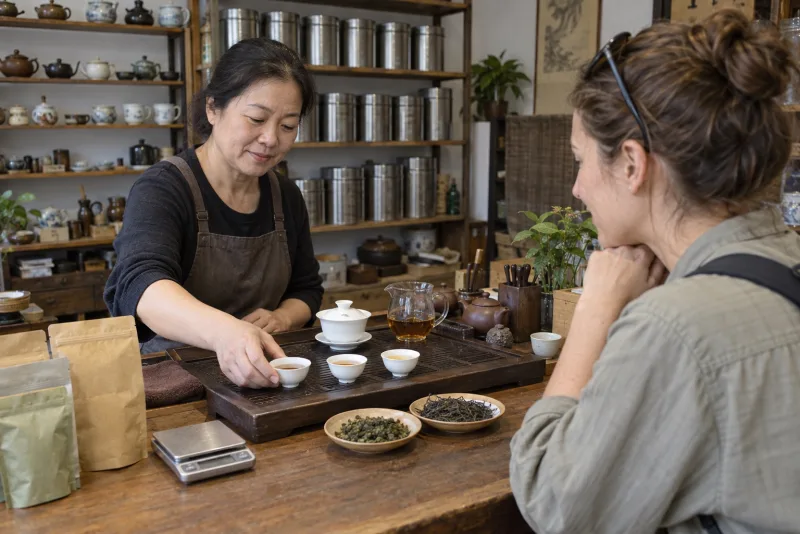
AI-generated illustration of a tea-shop tasting. This is not a photograph of a named business or a recommendation of a particular seller.
Agree on the Tasting Before Sitting Down
Ask whether sampling is available, whether there is a charge, and how much time it takes. Do not assume a retail sample and a paid tea experience are the same thing. If you only want to buy a small packet, say so at the start.
Once the tea is served, let it cool enough to taste comfortably. Notice whether you actually want another sip. You do not need the seller's vocabulary to describe your response: “I prefer this one,” “this tastes too strong for me,” or “can I compare it with a lighter option?” are useful observations.
Keep track of the samples. With permission, photograph each packet beside its cup, or ask the seller to write a short name and price on paper. If a later infusion tastes different, ask how the brewing method changed. Buy the experience you enjoyed, not just the most elaborate story.
Compare the Same Weight, Not Just the Price Tag
Before judging whether one tea costs more than another, confirm the currency, net weight of tea, and total amount payable. A small sample packet and a large gift box are not directly comparable. Ask whether tins, gift packaging, or other extras are included.
Use grams to remove ambiguity: “What is the price for 50 grams?” and “How many grams of tea are inside this box?” If the seller quotes another unit, ask them to write the equivalent quantity in grams before calculating.
Example only, not a market-price estimate: a 50-gram packet at RMB 60 works out to RMB 120 per 100 grams. A 100-gram packet at RMB 100 costs less per gram, although that does not automatically make it the better tea. The larger packet also means spending more today on a flavor you may not yet know well.
For a first trial, ask whether the shop sells a small quantity, such as 25 or 50 grams. Availability varies. Do not let a lower unit price turn a modest souvenir into a bulk purchase you did not intend.
Match the Packet to the Tea You Tasted
Before paying, point to your chosen sample and confirm that the tea being packed is the same product and grade. Ask for its name, producer or brand where applicable, origin information, net weight, and relevant production or packing details. Keep the product label and receipt.
If the price depends on a claim about origin, harvest, age, or rarity, ask what documentation supports it. A travel purchase is not the right moment to pay a substantial premium for a claim you cannot assess. You can choose something you like without buying a collector's story.
For a gift, look beyond the outer box. Can the recipient identify what is inside? Are the portions practical? Can the package close securely after opening? Two clearly labeled small packets can be more useful than an anonymous assortment with impressive presentation.
Take the Brewing Instructions Home Too
A shop may use equipment and a routine you do not have. Tell the seller whether you normally use a mug with an infuser, a teapot, or another method. Ask for instructions for that setup instead of copying a demonstration by sight.
- How many grams of leaves should I use?
- How much water should I add?
- What water temperature do you recommend?
- How long should the first infusion take?
- Can I brew the leaves again, and how should the timing change?
- How should I store this particular tea after opening?
Save the answers with a photograph of the exact packet. A note saying “three minutes” is not very useful if you have forgotten the quantity of leaves and water. If you are giving the tea away, include those instructions with it.
Pack for the Journey, Not Just the Gift Photo
Ask for securely closed packaging that fits your luggage. Keep identifying labels attached and avoid placing tea beside strongly scented toiletries or items likely to leak. Follow the seller's product-specific storage directions rather than assuming all teas need the same treatment.
Before taking any food or plant product across a border, check the destination's current customs and biosecurity guidance for that exact product. A shop's willingness to sell or wrap it does not establish whether you may import it. Mixed gift sets deserve particular attention because their ingredients may differ.
A Short Note to Save Before Shopping
Prepare this message with your own budget and translate it if needed: “I would like a small amount of tea for everyday drinking. My total budget is __ RMB. May I try two options in that range? Please tell me the net weight, total price, and brewing instructions before packing.”
Our guide to preparing for language barriers can help you keep the conversation simple. Ask one question at a time, confirm the answer, and keep the final choice clear.
The best outcome is straightforward: you leave with tea you enjoyed, a quantity you will use, a price you understood, and enough information to make another good cup at home.