
A community sports center can show a lively side of everyday city life in China. In one building or park complex, you may see badminton, basketball, table tennis, dance practice, family activities, or people waiting for their court time. It is not a sightseeing attraction, but a shared place where local routines are visible in a very direct way.
The right way to visit is to treat the facility as a working sports space. Court access, fees, opening hours, reservations, spectator rules, and equipment requirements can vary between cities and even between rooms in the same building. Check the current instructions, leave active play areas clear, and let the people using the facility set the pace.
Know What Kind of Place You Are Entering
A public sports complex, neighborhood recreation center, school facility, commercial court, and hotel gym can look similar from the outside but operate differently. Some have open public areas, while specific courts or rooms may be reserved, ticketed, or limited to registered users. Do not assume that an unlocked door or visible court means it is available to use.
Before making a special trip, check the venue's current official information for opening hours, event closures, and booking guidance. A short visit is easiest to include near another plan, such as an evening walk or a local neighborhood stop. If you hope to play, have a backup activity ready in case court times or entry rules do not work for a visitor that day.
Pause at the Entrance and Follow the Local Flow
Take a minute at the entrance to see where people check in, pay, store bags, or scan a reservation. There may be a front desk, a sign-in process, a security check, or a separate route for players and spectators. Follow the same sequence as local visitors rather than walking directly onto a court or through an access gate.
Some centers use online reservations, while others handle availability at a desk or through a local system. If staff ask for information, provide it through the normal channel. If you cannot complete a reservation, do not ask someone else to let you through under their booking; choose a public area or another activity instead.
Watch From the Edge, Not From the Court
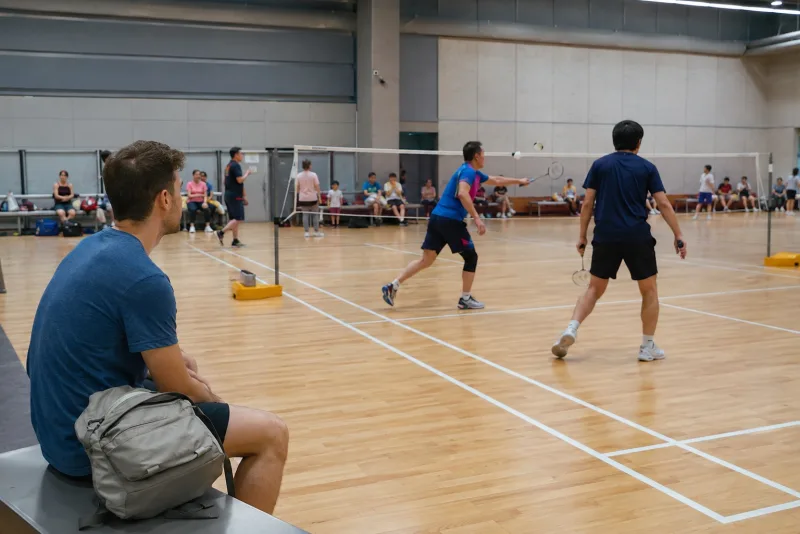
Badminton, basketball, and table tennis all need room beyond the marked playing area. Stand or sit only in designated viewing space, and keep clear of court doors, player paths, scoring tables, and the area behind a baseline. A shuttlecock, ball, or player can move quickly out of bounds.
Do not walk across an active court to save time. Wait for a break in play, use the outside route, and keep children close when moving around the facility. When you are watching, one quiet spot is enough. Avoid gathering a group at the edge of a court or shifting repeatedly for a better view.
Playing Requires a Clear Invitation or a Confirmed Booking
Watching a game, being asked to join a casual rally, and having a reserved court are three different things. Do not step into an open-looking court because players are resting or because there is a spare racket near the wall. Wait for a clear invitation from the people using the court, or use a court only after the venue confirms that your own booking is valid.
If a group invites you to try a few shots, keep the interaction simple. Ask where to stand, follow the existing game format, and stop when the group returns to its regular rotation. You do not need to turn a friendly invitation into a long session or request that people change teams around you.
Bring the Right Gear, but Do Not Borrow Without Asking
Indoor courts may have footwear, clothing, or equipment expectations designed to protect the surface and keep players safe. Check the venue's guidance rather than assuming outdoor shoes or travel sandals are suitable. If you plan to play, carry what you need or ask whether the facility has a normal rental process.
Do not pick up rackets, shuttles, balls, water bottles, or towels that belong to another player. Even when an item is on a bench, it may be part of the next game. Keep your own bag close to the wall or in the designated storage area so it does not become a trip hazard.
Respect Court Time and Shared Seating
People may have a fixed booking, a class slot, or a regular group that changes over at a specific time. Do not assume a court will remain free after the current players finish. When a new group arrives, give them space to organize, and move your belongings before they need the bench or the court-side area.
Seats near the court are often used by players waiting for their turn, older family members, or people taking a short break. Use only the space you need and do not spread luggage or shopping across several seats. A sports center works best when equipment, walkways, and seating can keep changing hands smoothly.
Photography Should Be Brief and Unobtrusive
A wide image of the building or an empty court may be possible where the venue permits it, but people exercising are not there to be filmed. Do not point a camera at a player during a rally, record a child, or set up a tripod beside a court. For a close photo or an extended video, ask the people involved and follow any staff instruction immediately.
Keep your phone away while you are walking near active courts. Never use a bright light or flash in a way that could distract a player. If the venue has signs limiting photography, those rules apply even when the court appears quiet.
Keep Changing Rooms and Personal Areas Private
Changing rooms, showers, lockers, first-aid areas, and staff rooms have a higher privacy expectation than the main hall. Enter only the areas appropriate for you, keep your phone put away, and do not photograph or wait in doorways. A quick look for the correct route is better than following another person through a restricted door.
Use lockers only through the venue's normal process, and keep passports, payment cards, and other essential travel documents with you or in secure accommodation. Do not leave valuables unattended on a court-side bench while you watch or play.
Notice Classes, Families, and Different Activity Levels
One hall may contain serious players, beginners, children in a class, and people meeting friends after work. Give instructors and organized groups room to set up. Do not enter a class, practice lane, or children's activity simply because there is an empty-looking space beside it.
If you are visiting with children, explain that the marked court is an activity area rather than an open running space. Help them move only along the designated edges, and wait with them in a safe place when players are collecting equipment or starting a game.
Useful Questions to Save
- Is this area open to visitors?
- Where can I watch from?
- Do I need a reservation to play?
- May I rent equipment here?
- May I take a photo of the court?
- Where is the exit?
Leave the Space Ready for the Next Group
When you finish watching or playing, collect your bag, rubbish, and any rental equipment. Return items exactly where staff direct and leave benches and walkways open for the next people arriving. Do not wait inside a changing-room entrance or court gate while deciding where to go next.
Before leaving the building, confirm your next address and transport option. For another everyday public-space experience that rewards quiet observation, see how to watch community dancing in China respectfully.
Quick Checklist
- Check current local opening, access, and booking guidance before making a special trip.
- Follow the entrance, payment, bag, and reservation process used by the venue.
- Watch only from designated or clearly safe edges of the activity area.
- Use a court only with a confirmed booking or clear invitation from its players.
- Keep shoes, bags, and equipment off active courts and clear of walkways.
- Do not photograph players, children, or private areas without permission.
- Keep changing rooms, lockers, and staff areas private.
- Return equipment and leave shared seating ready for the next group.
The Main Point
A Chinese community sports center can be a rewarding glimpse of local routine when you approach it as a shared facility rather than a performance space. Check the rules, give active games room, and be clear about whether you are watching, invited to join, or booked to play. Those small distinctions make the visit more comfortable for you and for everyone already using the court.