
Making a small bowl can be a memorable break from sightseeing in China. You sit down, work with your hands, and begin to understand why a shape that looks simple on a shelf takes practice to make. But there is one question worth asking before you book: when will your piece actually be ready to leave the studio?
The end of a lesson is not necessarily the end of the making process. Choose a workshop for both the activity you want and the time you have left in the city. If you are leaving tomorrow, an enjoyable class and a finished souvenir may need to be two separate purchases.
Choose the Process, Not Just the Workshop Photograph
“Pottery experience” can describe very different sessions. Read what you will physically do, what the instructor will finish afterward, and whether keeping a piece is included.
- Wheel throwing: shaping clay on a rotating wheel. Choose this if trying the wheel is the main attraction. Ask how much individual wheel time and hands-on guidance you receive, not just the total session length.
- Hand-building: forming clay without the wheel, using techniques such as pinching, coils, or slabs. This may suit someone more interested in a small sculptural object or a deliberately irregular form.
- Ceramic painting: decorating a prepared object. Ask what surface and materials you will use and whether another firing is required. Painting does not automatically mean same-day collection.
For a concrete example of the distinctions, PWS Ceramic Hub's own workshop descriptions explain specialist processes, including overglaze decoration followed by another firing. Use the provider's current course details to understand its format; this is not a claim that every listed course is a drop-in beginner session.
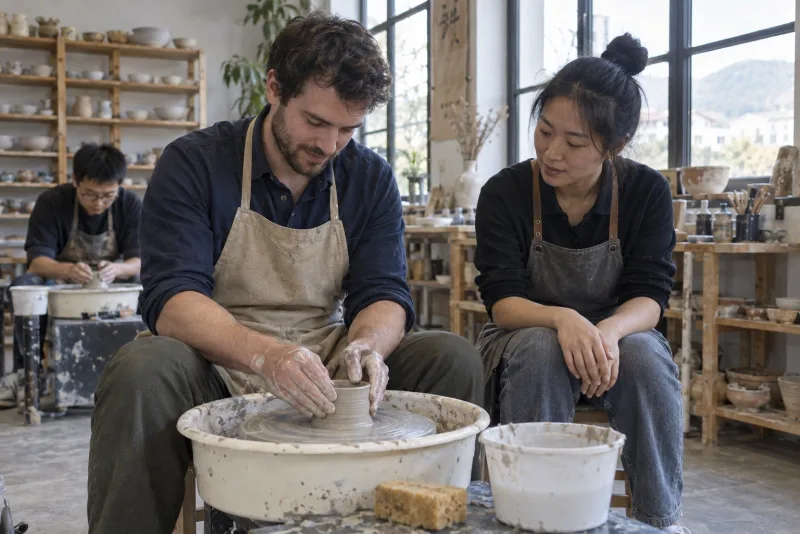
AI-generated illustration of a beginner pottery lesson in a Chinese studio. It does not depict PWS or any other named workshop.
Understand Why the Piece Stays Behind
In a typical fired-clay project, shaping is followed by drying and further finishing. Depending on the process, trimming, glazing, firing, and cooling still lie ahead. A studio may also wait for a suitable kiln load rather than firing each visitor's object separately. Ask for the actual schedule for your chosen project, not a general estimate for “pottery.”
The V&A's account of a potter's methods shows how making, glazing, and kiln work belong to a longer sequence. It is useful background, not a timetable for your class. The museum's discussion of ceramic firing also explains why results are not completely predictable.
Ask what happens if your piece cracks, changes shape, or does not survive firing. A beginner session should not be understood as a guarantee that every attempt becomes a finished object. Find out whether the fee buys instruction, a finished piece, or a combination, and what the studio offers if the result fails.
Match the Class to Your Departure Date
Leaving the city the next day: choose the experience only if you are comfortable leaving the work behind or the studio has confirmed a practical delivery arrangement. If holding a souvenir immediately matters most, consider a demonstration plus a separate finished item from the studio shop.
Staying for several more days: send your exact departure date before booking and ask whether collection by that date is realistic. “A few days” is not a confirmed pickup appointment. Keep some flexibility rather than making collection your final stop before a train.
Traveling onward within China: ask whether the studio can deliver to a later accommodation and whether that property agrees to receive the parcel. Confirm the arrival window, recipient details, and what happens if you move on before delivery. Do not assume a hotel will store it indefinitely.
Check What the Quoted Fee Includes
Two classes of the same duration may include different things. Before comparing prices, confirm:
- Instruction language, group size, and the amount of individual help.
- Clay or prepared objects, tools, and an apron.
- How many pieces you may attempt and how many may be kept.
- Any size limits or extra charges for a larger piece.
- Trimming, glazing, firing, and who completes each stage.
- Packaging, storage, collection, and delivery charges.
For children, check the studio's age requirements, supervision arrangements, and whether an accompanying adult needs a booking. For anyone who needs a particular seat height or working position, ask about the actual setup. A beautiful photograph does not answer those practical questions.
Keep the First Project Manageable
Tell the instructor you are a beginner and ask which small form fits the session. A low bowl or simple object can teach you more than struggling to finish a tall, complex design. Leave time for the demonstration and cleanup; do not treat the advertised duration as uninterrupted making time.
Wear clothes you do not mind getting marked, secure loose sleeves and hair, and follow the studio's tool and equipment instructions. Ask before photographing other students or handling work on drying shelves. Those pieces may belong to someone else and may still be fragile.
If you hope to use your object for food or drink, tell the studio before choosing the project. Ask whether the completed piece is intended for that use and what care instructions apply. Do not infer dishwasher, microwave, or food-use suitability from the shape alone.
Leave With a Collection Record, Not Just a Photo
Before leaving, photograph your work beside its identifying label with staff permission. Save the booking reference, the studio's contact details, your chosen finish, the expected completion window, and the collection or delivery arrangement.
If shipping is offered, confirm the destination, total charge, packaging, tracking, and how breakage or loss will be handled. International delivery is a separate question from domestic delivery; do not assume the studio offers both. Get the arrangement in writing before relying on it.
A useful message to send in advance is: “I am a beginner and leave this city on __. Which part of the process will I do myself? What is included in the price? When can the finished piece be collected, and what happens if it is not ready before I leave?” Our language preparation guide can help you keep that exchange clear.
Connect the Experience With the Craft
If ceramics are a major interest, UNESCO's official profile of Jingdezhen introduces the city's porcelain tradition and its place in the Creative Cities Network for Crafts and Folk Art. That context can enrich a studio visit, but a city's designation is not an endorsement of every workshop operating there.
You do not need to produce a perfect cup for the session to be worthwhile. Leave with a clearer understanding of the work behind ceramics, realistic expectations for your own piece, and a collection plan that fits the rest of your trip.