
The first surprise in a Chinese calligraphy lesson may be how much happens in a single line. The brush touches the paper, the hairs spread, the stroke changes width, and a small movement at the end alters its shape. Watching that process closely can make a page of writing feel very different from the printed characters on a street sign.
A short lesson is a chance to try the materials and learn what to look at. You can begin without reading Chinese, provided the teacher knows your experience level and can explain the characters you practise. Choose a session with time to watch, repeat, and receive feedback.
What Makes Calligraphy an Art?
UNESCO's account of Chinese calligraphy records its inscription on the Representative List of the Intangible Cultural Heritage of Humanity in 2009. It describes five script styles: seal, official, cursive, running, and regular. Calligraphy appears on objects ranging from letters and scrolls to fans, and continues through teaching and practice.
For a visitor, the useful starting point is the relationship between a written character and the way it is made. Ask the teacher to write one stroke slowly, then once at their normal pace. Look at the beginning, the change of width, and the finish. A still photograph preserves the result; a demonstration lets you see the decisions that produced it.
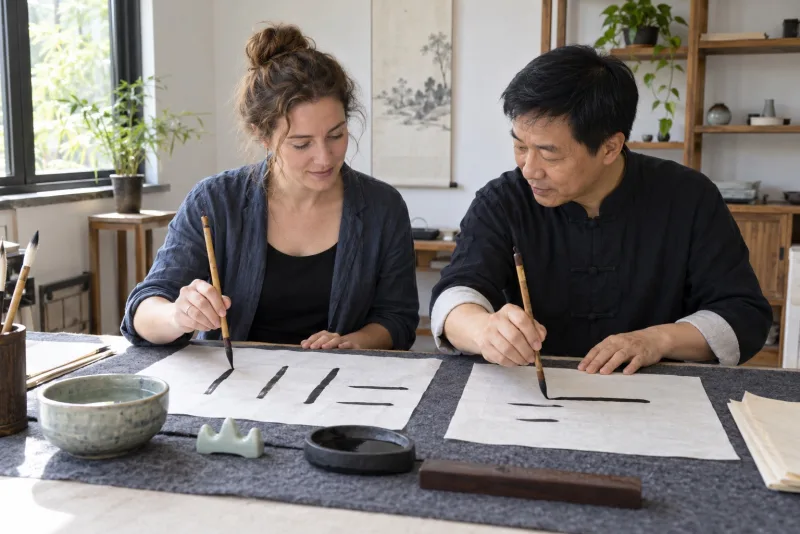
AI-generated illustration of a beginner brush-calligraphy lesson. It does not depict or recommend a particular teacher or studio.
Choose the Activity You Actually Want to Try
A calligraphy lesson, a brush-making demonstration, an ink workshop, and a rubbing activity offer different experiences. Read the programme carefully. If your priority is learning to use the brush, ask how much of the session you will spend writing and whether the teacher will correct your own attempts.
The Shanghai municipal government's introduction to the Royal Workshop of Chinese Brush and Ink illustrates this variety: it describes exhibitions, demonstrations of brush and ink craftsmanship, ink-stick activities, and rubbings. Those activities can deepen your understanding of the tools. Check the venue's current offering before assuming that a visit includes a writing lesson.
For a first session, tell the provider whether you can read any Chinese, what language you need for instruction, and whether you prefer a group or individual lesson. If you are left-handed or need a particular seating arrangement, mention it when booking so the teacher can prepare the workspace.
Start by Understanding the Tools on the Table
Ask which paper is for practice, where the brush should rest, and which container holds water rather than ink. A class may use prepared liquid ink, an ink stick and inkstone, or other teaching materials. Find out what you are using before adding water or dipping a brush.
Let the instructor demonstrate how to load the brush and arrange the paper. Follow their advice about grip, posture, and arm movement for the exercise. Trying to copy the appearance of a grip from a photograph is less helpful than having someone watch how you make a mark.
Put your phone and bag outside the working area, secure loose sleeves, and ask whether an apron is available. Keep spare sheets dry. These small preparations let you concentrate on the brush instead of protecting your belongings throughout the lesson.
Make Repetition Useful
Our suggestion for a beginner is to practise a few strokes with feedback before attempting a long phrase. After each demonstration, ask what one thing to change on the next attempt. It might be the direction of the brush, the amount of ink, the pace, or the position of one stroke relative to another.
Compare two attempts side by side. Where did the line become wider? Did the start land where you intended? Does the space between strokes look balanced? Those questions give you something specific to notice even when you cannot read the character independently.
Keep an early practice sheet as well as your final one. The comparison can be a more interesting record of the class than a single neatly presented page. Ask permission before photographing the teacher's demonstration or another student's work.
Learn the Meaning of What You Write
Before choosing a character or short phrase, ask for its meaning, pronunciation, and normal use. Request a clear model and a demonstration of the stroke order. If you want to write your name, have the teacher explain how the Chinese version was chosen; names can require more thought than a direct word-for-word translation.
If your session includes a final sheet, decide whether you want to write it yourself or watch the teacher produce a separate example. Ask before a seal, signature, dedication, or date is added so you understand whose work and words appear on the page.
Confirm What the Price and Time Cover
- How long is the session, and how much time is spent writing?
- What language is used, and is the class suitable for someone who reads no Chinese?
- How many students share the teacher's attention?
- Are brush, ink, paper, and enough practice sheets included?
- May you keep your practice pages and final sheet?
- Are mounting, a scroll, packaging, or take-home tools charged separately?
For a family booking, check the recommended age and the format for children. A programme involving several crafts may suit your group better than a session focused entirely on repeated writing. Match the activity to the participants rather than assuming all short workshops are the same.
Leave Time for the Paper to Dry
Before putting your work away, ask the instructor whether the ink is dry and how that particular paper should be carried. Avoid rolling or folding a damp sheet. If mounting or framing is offered, confirm the cost and collection time before relying on same-day completion.
Save a photograph of the character with a note of its meaning and the teacher's main advice. If you want to practise at home, ask which simple materials suit the method you learned. You can decide about a larger set after you know what you enjoy using.
A useful booking message is: “I am a complete beginner and do not read Chinese. I would like to learn basic brush strokes and practise a simple character with guidance. What is included, and can I take my work away after the session?” Our language preparation guide can help you make that exchange clear.
After the lesson, a brushstroke in a museum or shop window may catch your attention for a new reason. You have felt how the tool moves and how carefully a line is made. That small change in what you notice can stay with you throughout the trip.