
A queue is one of the simplest parts of a travel day, but it can feel less obvious when the language, layout, and payment flow are unfamiliar. In China, a short line may form at a bakery, a museum security point, a metro gate, a clinic counter, or a small neighborhood shop. The useful habit is not to guess quickly, but to take a few seconds to see what each person is waiting for.
There is no single rule for every venue. Some places use a clear physical line, some call a number, and others separate ordering, paying, and collecting into different counters. A calm pause, a prepared phone, and attention to the people in front of you will usually make the next step clear.
Watch the Flow Before You Step In
When you arrive, look for the direction in which customers are moving. Notice where people enter the line, where they place an order, where they pay, and where they collect an item. A counter can look like one queue while actually serving two or three separate steps.
If the purpose is not clear, stand to one side rather than joining the nearest group immediately. A staff member may point you to an ordering screen, a payment counter, or a pickup shelf. This short pause is better than reaching the counter and discovering that you have skipped an earlier step.
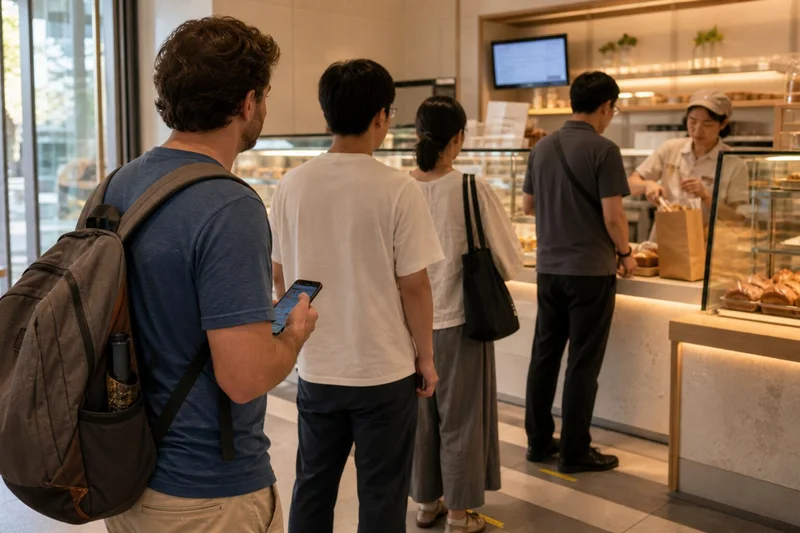
Separate Ordering, Payment, and Pickup
Many cafes, bakeries, food courts, and busy service counters use separate places for ordering and collection. The people waiting nearest the counter may already have paid and be listening for a number or watching a screen. Do not assume that this is the line for a new order.
Before joining, check whether customers are holding menus, placing items on a tray, showing a payment code, or waiting with a receipt. If you are unsure, a simple question in a translation app such as “Where should I queue to order?” is enough. When you have paid, move away from the ordering point and wait where the venue directs you.
Use Number Systems Patiently
A paper ticket, a screen number, a printed receipt, or a message in an app may mark your place. Keep the number available and watch for the collection point instead of staying directly at the payment counter. Staff often need that space to serve the next customer.
Numbers may be called aloud, displayed briefly, or grouped by counter. If you miss yours, do not push forward through other customers. Show the receipt or number to a staff member when there is a natural opening. At a busy venue, it is normal to wait a little longer while the flow is sorted out.
Keep a Small, Clear Personal Space
Stand close enough that the line remains understandable, but avoid pressing against the person ahead or placing a bag where someone needs to pass. In narrow spaces, keep luggage, umbrellas, shopping bags, and a companion behind or beside you rather than across the walkway.
If you are traveling as a group, one person can usually stay in line while the others wait outside the immediate counter area. Rejoin only when there is room. This helps staff, other customers, and anyone trying to move between the counter and the exit.
Prepare Your Phone Before It Is Your Turn
Mobile payment and QR codes are common, so open the needed app, payment code, translation screen, or booking confirmation before reaching the front. This is especially helpful when a line moves quickly. Keep a backup payment option available in case a small business uses a different method or your phone connection is slow.
For a broader payment plan, see how international travelers can pay in China. Saving key information offline also reduces pressure at a counter; this guide explains what to save offline before traveling to China.
Follow Staff Direction at Controlled Entry Points
At museums, stations, security checks, attractions, and other controlled entrances, follow the marked route and staff instructions even when the line bends or splits. A rope barrier, a sign, a checkpoint, or an attendant may separate ticket holders, bag screening, group entry, and accessible access.
Let people exit before moving into a doorway, lift, train carriage, or gate area. Keep documents and reservation details ready, but wait until a staff member or the queue movement makes it clear that it is your turn to show them. For attraction entry preparation, read how to prepare for popular attraction entry rules in China.
Do Not Turn a Queue Into a Photo Stop
A busy counter or waiting area may be visually interesting, but it is also a place where people are trying to finish an errand. Take a quick wide photograph only when it does not slow the line or point a camera closely at customers and staff. Put the phone away when you are being helped.
Do not stop in a doorway, use a flash, or hold a phone above other people to record a queue. If you want a closer image of a stall or counter, ask first and take it after your transaction is complete.
What to Do When You Make a Mistake
If you realize that you have joined the wrong line or stepped ahead of someone, a small gesture and a step back are usually enough. You do not need a long explanation. Let the other person continue, find the correct place, and keep the situation moving.
When the venue is crowded, avoid arguing about who arrived first. Staff direction, visible number systems, and the flow already established by customers are the best guide. Patience is more useful than trying to solve a brief misunderstanding at the counter.
Useful Questions to Save
- Where should I queue to order?
- Is this line for payment or pickup?
- Do I need to take a number?
- Where should I wait after paying?
- Could you show me the collection point?
- May I take a photo after I have finished?
Quick Checklist
- Watch how customers move before joining a line.
- Check whether ordering, payment, and pickup are separate steps.
- Keep any receipt or number visible until the transaction is complete.
- Give people, staff, doorways, and walkways enough space.
- Open payment, translation, and booking tools before reaching the counter.
- Follow staff direction at security, station, and attraction entry points.
- Take photos only when they do not interrupt people waiting or working.
The Main Point
Queuing in China is easier when you read the local flow instead of treating every counter as the same kind of line. Notice the purpose of each queue, prepare your phone early, and keep shared space clear. Those small choices help you move through everyday situations smoothly and respectfully.