
Some of the most memorable parts of a China trip happen away from a famous attraction: a shaded sidewalk, a small fruit shop, people collecting dinner ingredients, children returning from school, or neighbors sitting outside a local convenience store. Exploring a neighborhood can add texture to a travel day, but it works best when you remember that it is first a place where people live their everyday lives.
A respectful neighborhood walk is not about entering every lane or photographing every person. It is about choosing a public route, noticing the rhythm of the area, supporting small businesses when appropriate, and giving residents the same privacy you would expect at home.
Choose a Public Route, Not a Private Shortcut
Start with public streets, sidewalks, parks, riverside paths, and commercial lanes. Some residential compounds have gates, staff, visitor registration, or access rules that are not intended for casual sightseeing. Do not follow a resident through a controlled entrance, argue with security staff, or assume that a quiet path is open to everyone.
If an entrance is clearly public, follow the posted rules and keep to normal visitor routes. When a neighborhood has no obvious public route, enjoy the streets around it instead. The goal is to understand a local area without turning somebody’s home into your destination.
Plan One Simple Walk Around a Real Purpose
Give the walk a light purpose: reach a cafe, browse a local bookshop, find a public park entrance, or connect a metro station to dinner. A short route with a clear end point is easier than wandering until you are tired or lost. Save the start, destination, and nearest transport stop in Chinese before you leave.
Do not judge a neighborhood by how quickly it resembles a postcard. The ordinary parts are often the most revealing: delivery bikes stopping briefly, residents choosing groceries, a repair counter, or people meeting at the entrance to a building.
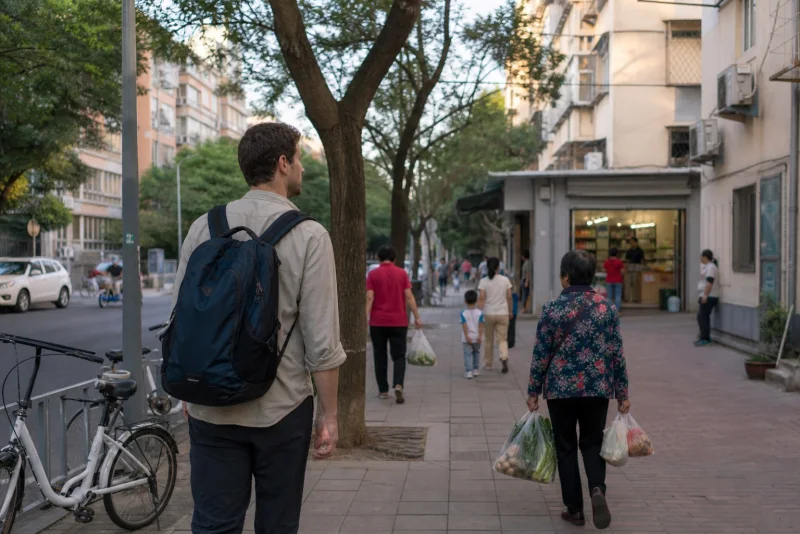
Read the Pace of the Street
Keep to one side of the pavement, especially where people are carrying bags, pushing strollers, or moving around parked bicycles and scooters. Avoid stopping in front of a shop doorway, a building entrance, a delivery point, or a narrow gate while you check your map.
Watch for vehicles entering from side streets and for scooters that may pass quietly. A relaxed pace is useful, but stay aware of the space around you. If you need to look up directions or take a photograph, step aside first.
Use Local Shops as a Normal Customer
A small grocery, bakery, pharmacy, fruit stall, or convenience shop can be a natural way to pause during a walk. Browse without blocking the counter, ask before handling items that are not self-service, and keep a simple purchase simple. You do not need to turn every stop into an interview or a filmed experience.
Payment methods vary by business, so have your phone ready and a backup option available before you reach the counter. For wider preparation, see how international travelers can pay in China.
Protect Privacy When Taking Photos
A wide street scene can be a good memory of a neighborhood, but residents, children, staff, and delivery riders are not props. Avoid close-up photographs of people without permission, do not point a camera into windows or courtyards, and do not linger outside a building entrance for a portrait angle.
Ask before making a close photograph of a shop, vendor, or resident. Put the camera away when somebody seems uncomfortable. A quick wide photo of the public street is usually enough to remember the atmosphere without interrupting people’s day.
Keep Noise and Conversation Modest
Residential streets can be quieter than central shopping areas. Use headphones, keep phone calls short, and avoid gathering a group around a doorway or bench. If you are traveling with companions, regroup in a wider public space instead of stopping in the middle of a narrow pavement.
Small gestures matter: do not leave litter, do not sit on private steps, and do not move a bicycle, package, stool, or plant to improve a photograph. Treat the street as a shared working space, not an empty backdrop.
Know When to Switch to Another Form of Transport
A neighborhood walk is best when it remains easy. If the weather changes, roads become difficult to cross, or you are carrying purchases, move to the next transport step rather than forcing a long route. Save a nearby metro station, bus stop, or ride-hailing pickup point before your phone battery gets low.
For short city connections, a shared bicycle can work when local access, road conditions, and parking are all clear. Read how to use shared bicycles in China as a first-time visitor before relying on one for a timed journey.
Leave the Area as Smoothly as You Arrived
Before you finish, check the next address and decide where you will meet a car or enter a station. Large residential blocks may have different pickup points from the street where you began. Stand clear of gates and driveways while you wait.
If you need a taxi or ride-hailing car, use a safe, identifiable pickup spot rather than asking a driver to stop in a narrow residential lane. This guide covers the basics: how to take taxis and ride-hailing in China as an international visitor.
Useful Questions to Save
- Is this street open to visitors?
- Where is the nearest public entrance or exit?
- May I take a photo of your shop?
- Where is the nearest metro or bus stop?
- Where is a safe taxi pickup point?
- How do I pay for this item?
Quick Checklist
- Choose public streets and do not enter controlled residential areas casually.
- Give the walk a simple start and end point.
- Keep doorways, pavements, and delivery areas clear.
- Browse local shops as a normal customer, not as a spectacle.
- Protect residents’ privacy when taking photographs.
- Keep noise low and do not move other people’s belongings.
- Save a transport backup before you leave the area.
The Main Point
A Chinese neighborhood can offer a valuable view of everyday city life when you approach it with restraint. Stay in public spaces, notice more than you record, and let the practical rhythms of the street guide the visit. Respectful curiosity makes the experience better for you and for the people who call the area home.