
The first few minutes inside a hotel room can make the rest of a travel day easier. You have luggage, a new key card, an unfamiliar layout, and often a phone that needs charging. A short, calm routine helps you understand the room before you unpack or head straight back out.
Hotels in China vary widely by city, price level, and property, so there is no single room setup to expect. Rather than looking for every amenity at once, focus on the basics: confirm the room is the one you reserved, understand how access works, keep the entry clear, and know how to ask for help if something is missing.
Keep Your Key Card and Room Number Private
Put the key card, room slip, and passport away before you start exploring the room. Avoid leaving a room number visible on a desk, in a lift, or in a photograph. If the lift needs a card to reach guest floors, test that access once while you still remember the route from reception.
Some cards also activate the room power when placed in a wall slot, while others do not. Watch what happens when you enter rather than forcing a card into an unfamiliar slot. If you receive more than one card, decide who will carry each one before you split up for the day.
Do a Quick Check Before You Unpack
Take one slow look around before opening every bag. Confirm the bed arrangement, room type, and obvious basics such as towels, lights, air conditioning controls, and the bathroom door. You do not need to conduct an inspection, but this is the easiest moment to notice a clear mismatch with the room you booked or a problem that needs attention.
If something important is missing or not working, take a clear photo if useful and contact the front desk promptly. A short, specific request is easier to handle than discovering the issue later when you are tired or ready to sleep.
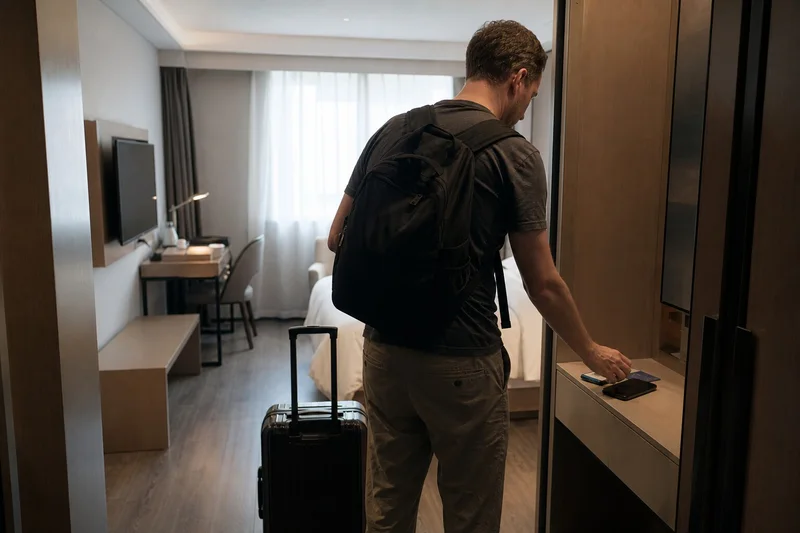
Make the Entry Area Easy to Use
Place a suitcase where it does not block the door, bathroom, wardrobe, or route to the bed. In a compact room, opening one bag at a time can save more space than spreading everything across the floor. Keep the key card, phone, and a small wallet in one predictable place near the entrance or desk.
Before leaving the room, make sure nothing is hanging from a door handle or tucked behind luggage. This small habit reduces the chance of forgetting a charging cable, passport holder, or shopping bag during an early departure.
Find the Controls You Will Need Tonight
Locate the main light switch, bedside lights, air conditioning panel, curtains, bathroom fan, and power sockets. Settings may be in English, Chinese, icons, or a combination. If a control is not clear, take a photo or ask the front desk instead of changing every setting at once.
Check whether your phone charger fits safely and whether you need a travel adapter. Keep the phone and power bank charging where you can see them, rather than on a crowded bed or beside a sink. For a wider charging plan, see power bank and phone charging tips for China travel.
Connect to Wi-Fi Without Sharing More Than Needed
Look for the network name and access instructions in the room, on the desk, or at reception. Some hotels use a password; others may ask for a room number, phone number, or a simple verification step. Use the information given by the hotel and avoid connecting to similarly named networks that are not clearly identified.
If you need help, show the Wi-Fi page or a screenshot to reception. Keep your own account passwords private, and do not hand an unlocked phone to another person unless you are comfortable doing so. Your travel SIM or eSIM remains useful as a backup when hotel Wi-Fi is slow or unavailable.
Check the Bathroom and Drinking-Water Setup
Find the toilet flush, shower controls, towels, and any labels for hot water. A shower may need a few moments to warm up, and controls are not always arranged the same way as at home. Test them briefly before a late shower rather than when you are in a hurry.
Do not assume tap water is intended for drinking. Use sealed bottled water supplied by the hotel or water you have bought yourself, and follow any room guidance for the kettle or water dispenser. If you have dietary or health-related needs, keep a labeled item or translation note ready for reception rather than relying on memory.
Know the Best Way to Ask the Front Desk
For a simple room question, bring the key-card sleeve or show the room number discreetly on your phone. A translation app can help with requests about an extra towel, air conditioning, Wi-Fi, a wake-up call, or a maintenance issue. Keep the request focused on one thing at a time.
When you make a request that affects a charge, delivery, deposit, or checkout, ask what is included and whether there is a cost before agreeing. This guide explains what to confirm about hotel deposits in China.
Prepare for Your Next Exit
Before you leave for dinner, sightseeing, or a walk, save the hotel name and address in Chinese, keep the key card with you, and confirm how you will return. A screenshot of the entrance, nearest metro station, or pickup point can be more useful than relying on a remembered landmark after dark.
If you have arrived before check-in or have time between checkout and transport, plan luggage rather than leaving it in a public area. Read how to plan luggage storage and check-in gaps during China travel for a practical approach.
Quick Checklist
- Put the key card, room number, and passport away before settling in.
- Confirm the room type and report any important issue before unpacking.
- Keep luggage clear of the door, bathroom, and walking route.
- Locate basic lights, air conditioning, curtains, sockets, and bathroom controls.
- Use the hotel-provided Wi-Fi details and keep account passwords private.
- Use sealed drinking water and ask when a room instruction is unclear.
- Save the hotel address and bring the key card every time you go out.
The Main Point
You do not need to master every detail of a China hotel room on arrival. A focused first fifteen minutes is enough: protect your room information, make the space easy to use, test the essentials, and ask early when something does not match. That short routine gives the rest of your stay a calmer start.