
Updated on June 18, 2026. Choosing between high-speed rail and a domestic flight in China is not just a question of which ticket looks faster. For overseas travelers, the better comparison is the whole door-to-door journey: where the station or airport sits, how early you need to arrive, how much luggage you have, and what happens if there is a delay.
China's high-speed rail network is extensive, and domestic flights can still be useful on longer routes. The right choice depends on the specific city pair, your travel day, and how much uncertainty your itinerary can absorb. This guide gives a decision framework rather than a fixed route recommendation.
If you are still learning how China's transport system works, start with the China high-speed rail ticket and station guide and the broader guide to using China high-speed rail as an international traveler.

Compare the total travel time, not only the ticket time
A two-hour flight and a five-hour train do not automatically mean the flight saves three hours. Airports usually require earlier arrival, longer security timing, baggage handling, boarding, possible remote gates, and a longer trip from the airport into the city. Railway stations also require security checks and walking time, but many major stations are closer to city centers or metro networks than airports are.
For a fair comparison, add each step: hotel to station or airport, check-in or security, waiting time, actual ride or flight time, arrival exit time, luggage collection if needed, and final transfer to the next hotel or attraction. The result is often different from the number printed on the ticket.
This is especially important on days with hotel checkout, a fixed museum reservation, a dinner booking, or a same-day connection. A route that looks shorter can still be the riskier choice if it has more moving parts.
When high-speed rail often feels easier
High-speed rail often works well for medium-distance routes where the train station is reasonably connected to the city and the train time is competitive with the airport process. It can also feel easier when travelers want a more predictable boarding process, a direct city-to-city rhythm, and less concern about weather-related flight disruption.
Rail can be especially practical when you are moving between cities such as Beijing, Shanghai, Hangzhou, Suzhou, Nanjing, Xi'an, Zhengzhou, Wuhan, Changsha, Guangzhou, and Shenzhen, depending on the exact route. The key is not the city name alone. It is whether the station, train time, seat availability, luggage plan, and arrival timing fit your day.
Train stations can still be large and busy. First-time visitors should leave time for passport checks, ticket gates, security screening, platform access, food or water, and finding the correct exit after arrival. For station-specific habits, read the high-speed rail station guide.
When a domestic flight may make more sense
A domestic flight may be the better choice when the distance is long, the rail journey takes most of the day, or the route has a convenient airport-to-airport connection. It can also make sense when the traveler is connecting from an international flight and staying near the same airport, or when the destination has limited rail convenience.
Flights can become less attractive when the airport is far from the city, the departure time forces a very early start, checked luggage adds waiting time, or the arrival airport requires a long transfer to the hotel. Delays, weather, air traffic control, and schedule changes should also be considered, especially when the next item on the itinerary is fixed.
For arrival planning, see how to choose the right China arrival airport. If your China trip includes possible flight disruption, also read what to do if your flight to China is delayed, changed, or arrives late.
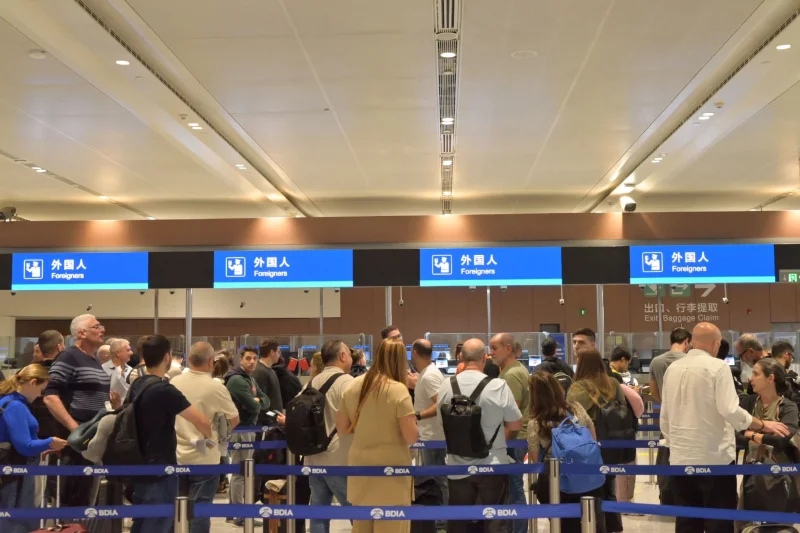
Station and airport location can change the answer
The same train time can feel very different depending on the station. Some cities have several railway stations, and not every high-speed train uses the station closest to your hotel. A station name that looks familiar may still be on the edge of the city, while another station may connect more directly to a metro line or taxi route.
Airports have the same issue. A city may have more than one airport, and the airport with the cheaper ticket may not be the airport that makes the day easier. Before choosing, check the exact station or airport name, transfer time from your hotel, transfer time after arrival, and how comfortable you are navigating with luggage.
For overseas travelers, this is one reason to avoid making a transport decision based only on the cheapest or fastest displayed ticket. A slightly longer ride can be easier if it reduces transfer complexity.
Luggage and mobility are part of the decision
Luggage can change the better option. Train travel usually lets travelers keep bags nearby, but moving through a large station, escalators, platform access, and carriage boarding still require effort. Flights may handle checked luggage more cleanly during the journey itself, but baggage drop, collection, and airport transfers add time.
Families, older travelers, travelers with large suitcases, and travelers arriving after a long international flight should think about the physical side of the day. The easiest transport choice is not always the one with the shortest ride time. It is often the one with fewer stressful transitions.
If you already know the day will involve heavy luggage, consider whether a later departure, a station closer to the hotel, or an overnight stop would make the route more realistic.
Delay risk matters more on tight travel days
Both trains and flights can be delayed, but the risk feels different. High-speed trains are often relatively predictable, though weather, operational issues, peak travel periods, and station crowding can still affect the day. Flights can be more exposed to weather, airport congestion, aircraft rotation, and air traffic control.
The tighter your itinerary, the more important delay risk becomes. A transport delay is not only about arriving late. It can affect hotel check-in, attraction entry windows, dinner plans, onward connections, and sleep. This is why a route with a slightly longer scheduled time can still be the better choice if it reduces uncertainty.
For a broader planning principle, see why a realistic China itinerary needs buffer time.
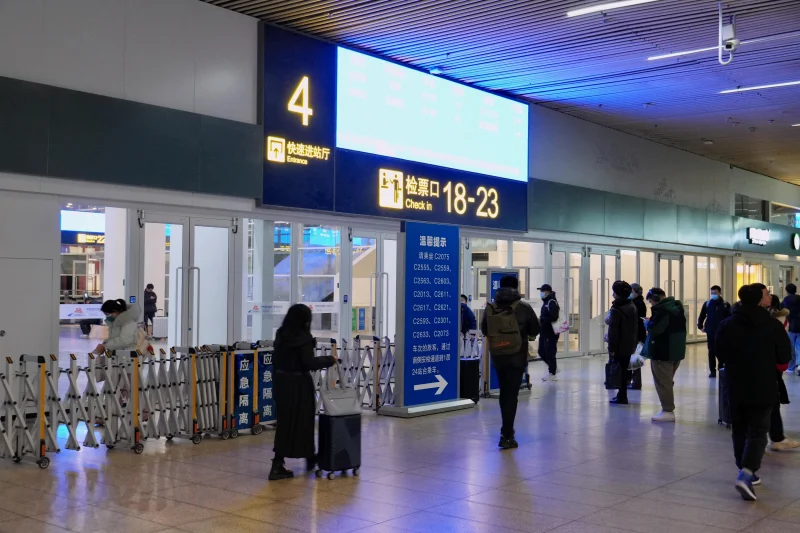
Arrival and departure days deserve extra caution
On the first day after an international arrival, avoid treating a domestic flight or long rail transfer as if you were already rested and fully oriented. You may still need to set up mobile data, test payment apps, find the hotel, recover from the flight, and understand local transport signs.
On the final day, the priority should usually be reaching the departure airport with enough margin. A same-day intercity train or domestic flight before an international departure can work in some cases, but it should be planned with clear buffers and a realistic backup mindset.
For many first-time visitors, the better experience is to keep arrival and departure days lighter and place major intercity movement on a normal middle travel day.
A simple decision checklist
Before choosing high-speed rail or a domestic flight, compare these points:
- What is the real door-to-door time from hotel to hotel?
- Which exact station or airport will you use, and how far is it from where you are staying?
- How much earlier do you need to arrive for security, check-in, boarding, or platform access?
- Will you have checked luggage, large suitcases, children, older travelers, or mobility needs?
- Is the next activity flexible, or does it have a fixed entry or reservation time?
- What happens if the train or flight is delayed by one to three hours?
- Will the arrival time still allow a calm transfer, meal, payment setup, and sleep?
Final thought
High-speed rail and domestic flights are both useful in China. The mistake is choosing based only on the headline travel time or the cheapest ticket. A good decision looks at the full day: station and airport location, transfer complexity, luggage, delay risk, energy level, and schedule buffers.
For overseas travelers, the best option is usually the one that keeps the trip understandable and resilient. If a transport choice protects the rest of the day, it may be the right choice even when another ticket looks faster on paper.