
Updated on June 3, 2026. China high-speed rail is one of the easiest ways for international travelers to move between major cities, but the station process can feel different from airports in Europe, North America, or Australia. Tickets are real-name tickets, the passport used for purchase matters, every passenger goes through security, and ticket gates usually close before departure.
This guide focuses on the practical station flow: buying a ticket, using a passport, entering the station, passing security, finding the waiting room and gate, boarding the correct carriage, handling luggage, and planning enough time for a missed-train risk. It is meant to complement our earlier overview, Using China High-Speed Rail as an International Traveler, which explains why rail works well for many China itineraries.
The main official reference is the 12306 China Railway English FAQ. 12306 is the official China Railway ticketing platform; its English website says that the railway department will not handle ticketing problems that occur on other websites.

First principle: your passport is part of the ticket
China Railway uses real-name ticketing. The 12306 English FAQ states that passengers should show a valid identity document when purchasing real-name tickets, and that foreign passengers can purchase real-name tickets with valid passports usable according to relevant rules. For 12306 English website purchases, the accepted ID document is a valid foreign passport.
In practical terms, the passport number entered during booking must match the original passport you carry to the station. Do not book with an old passport, a shortened name, a nickname, or a different document unless you are certain it is accepted. The same document is used for ticket purchase, station check-in, and exit from the destination station.
If your passport was renewed after booking, or your name was entered incorrectly, fix the ticket before travel. Do not wait until the gate is closing.
Where international travelers can buy tickets
12306 lists several official ticketing channels, including station ticket counters, automatic ticketing machines, 12306.cn or the 12306 mobile app, ticket hotline where available, and other railway sales channels. For most foreign visitors, the practical choices are 12306, a station ticket counter, or a service provider that books through official railway channels.
When using 12306, create the account and passenger profile before the travel day if possible. Do not wait until the morning you are trying to board. The 12306 English website provides purchase, endorsement, refund, and destination-change services. It also states that information query and ticket refund services are available 24 hours a day a day, while ticket sales and endorsement services run from 5:00 to 1:00 the next day in normal operation, with a different Tuesday schedule on Tuesday.
This is the type of detail that can change, so always check the current 12306 page before relying on a late-night change or early-morning departure purchase.
E-ticket, itinerary sheet, and what you actually need at the station
12306 says both e-tickets and paper tickets are used. A railway e-ticket is the electronic voucher for the railway passenger transport contract. For e-tickets, passengers should keep the ticket information and the valid ID document used to buy the ticket, and show that ID document to enter and exit the station and board the train.
The itinerary sheet is useful for your records and reimbursement, but it is not the same as the boarding credential. 12306 specifically says passengers can print or download the e-ticket itinerary sheet after buying an e-ticket, but the key item at the station is still the valid ID document used for purchase.
For international travelers, that usually means: keep your passport in hand, keep the booking confirmation on your phone, and arrive early enough in case manual verification is needed.
How early should you arrive at the station?
A China high-speed rail station usually has several steps: station entrance, security check, ID or ticket verification, waiting hall, ticket gate, platform, carriage door, seat check, and exit at the destination station. In large cities, the distance between the curb and the platform can be significant because of crowds, escalators, and waiting areas.
12306 advises passengers to reserve enough time because there may be queues at ticket windows, security checks, ID verification counters, ticket gates, and baggage consignment counters. It also advises passengers to pay attention to station announcements, displays, staff reminders, platform information, waiting room, check-in gate, ticket-check time, departure time, and other key information.
For a first-time foreign visitor, a practical rule is:
- Small station, light luggage, familiar traveler: arriving about 45 minutes before departure may be enough in normal conditions.
- Major city station, foreign passport, luggage: arriving 60 to 90 minutes before departure is usually safer.
- Family, senior traveler, children, or holiday period: arrive earlier and avoid tight same-day transfers.
Do not plan a taxi arrival and train departure as if the station were a small subway stop. Beijing South, Shanghai Hongqiao, Guangzhou South, Shenzhen North, Hangzhou East, Xi'an North, and Chengdu East can all be large and busy.
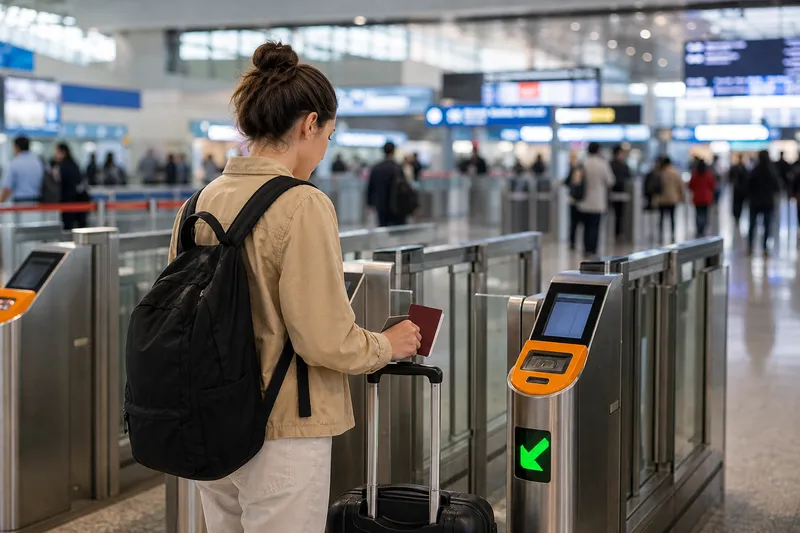
Security check is compulsory
According to the 12306 English FAQ, all passengers and their belongings are subject to security check. When entering the station, baggage and belongings go through inspection equipment and passengers pass through a security gate. There may be queues, so travelers should reserve enough time.
This matters for packing. Items that are normal in checked airline baggage may still be restricted in railway stations. 12306 lists prohibited or restricted categories such as guns, explosives, certain sharp or dangerous instruments, flammable and explosive items, toxic or corrosive items, items that endanger railway safety or public health, and limited quantities for some daily-use products such as nail polish, sprays, matches, and lighters.
For ordinary travelers, the safest packing rule is simple: avoid knives, tools, large sprays, flammable liquids, unusual batteries, strong-smelling items, and anything that looks hard to explain. If you are carrying medicine, baby items, mobility equipment, or work equipment, leave time for inspection and keep documents available.
Luggage limits: do not pack like an airport transfer
12306 gives free carry-on luggage limits by passenger type. For most adult passengers, the listed free carry-on luggage limit is 20 kg; children have 10 kg, and diplomats have 35 kg. It also states maximum dimensions for each item: 130 cm in total for EMU trains and 160 cm for traditional trains, with an individual item weight limit of 20 kg. Foldable wheelchairs used by people with disabilities are not included in that range.
These official limits are more detailed than most tourists remember. For first-time visitors, the practical issue is not only weight. It is whether you can move through security, escalators, waiting halls, gates, and the narrow space near carriage doors without stress. One medium suitcase and one small backpack is much easier than two oversize bags.
Finding the gate, platform, carriage, and seat
After security, check the departure display and your ticket information. Chinese high-speed train numbers usually begin with letters such as G or D. The station display shows the train number, destination, departure time, gate, status, and sometimes platform information. Gate information can appear after you arrive in the waiting hall, so keep checking the display.
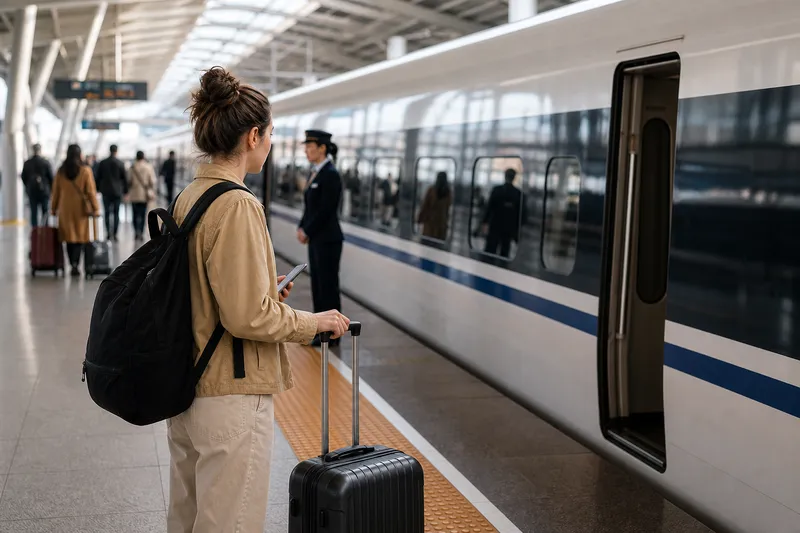
When the gate opens, passengers go through quickly and then move down to the platform. Look for your carriage number before the train arrives. Many platforms have carriage markers on the ground or display screens. If you enter the wrong carriage, you can usually walk through the train, but it is easier to start at the correct place.
At destination arrival, keep your passport available. Some stations may check the document or ticket information again when exiting.
What if you miss the train?
12306 says passengers should take the train according to the date and train number indicated on the ticket. A through ticket is valid only for the indicated day and train, and getting on or off mid-route can make the unused section invalid. Endorsement, refund, and destination-change rules depend on current railway policy, ticket type, route, and timing before departure.
Do not assume that missing a high-speed train works like missing an urban subway. If you are late, go to the service counter immediately with your passport and ticket information. Staff can tell you whether endorsement, refund, or a new ticket is possible. During holidays or popular travel days, last-minute seats may sell out.
If your flight arrival connects to a train, leave a real buffer. Immigration, baggage, customs, airport transfer, traffic, and station security can all add time. Our guide on what to do if your flight to China is delayed or changed explains why same-day rail connections can be risky on arrival day.
Three practical examples
- Example 1: Shanghai to Hangzhou day trip. A traveler lands the previous day, checks into a hotel, and takes the train the next morning. This is usually comfortable because the train is not on the same day as the international flight.
- Example 2: Beijing airport to Beijing South to Xi'an North on the same day. This can work only with a large buffer, especially if the traveler has luggage and a foreign passport. A tight transfer is risky if the international flight is delayed.
- Example 3: family with two suitcases during a holiday period. Buy tickets early, arrive early, and choose a hotel near the departure station if the train leaves early.
High-speed rail checklist for international travelers
- The ticket name and passport number match the original passport.
- The passport used to buy the ticket is with the traveler at the station.
- The train number, station name, and departure time are checked carefully.
- The city has multiple stations, and the correct one is saved in Chinese and English.
- Arrival at the station leaves enough for security, ID verification, gate, and platform walking.
- Luggage is within practical limits and can be carried without help.
- Payment, phone data, and offline confirmation are ready.
- A backup plan exists if the flight, car transfer, or first train runs late.
For phone data and app access before a rail trip, read our China SIM card, eSIM, and internet access guide. For first-night hotel and train-day planning, our China hotel check-in guide can help you avoid a late-night arrival conflict between arrival day, hotel registration, and early-morning train timing.
If you want help checking whether a multi-city China route is comfortable for your passport, luggage, station transfers, and family pace, use the Jiangmi Travel official contact page. We can help with practical travel flow, while ticket rules and station procedures always follow current China Railway rules.