
An overnight train can turn a long intercity journey into part of the trip rather than a full day lost to transport. It can also feel unfamiliar if you have never boarded with a small bag, found a berth, settled for the night, and arrived in a new city before breakfast.
The practical question is not whether an overnight train is always better than a flight or daytime rail. It is whether the departure time, arrival time, berth type, station location, and your energy level make sense for this particular route. Train types and facilities vary, so confirm the current details for your own service before you rely on a specific setup.
Choose the Train for the Arrival It Creates
Look beyond the number of hours on the train. An arrival at 6 a.m. may sound efficient, but it changes the first hours in the next city. You may need somewhere to wait before hotel check-in, a plan for breakfast, luggage, a shower, and a lighter first activity.
Before booking, check the departure station, expected arrival time, station location, and how you will reach the hotel. For large-station planning, read what to know about large railway stations in China.
Keep a Night-Train Bag Separate
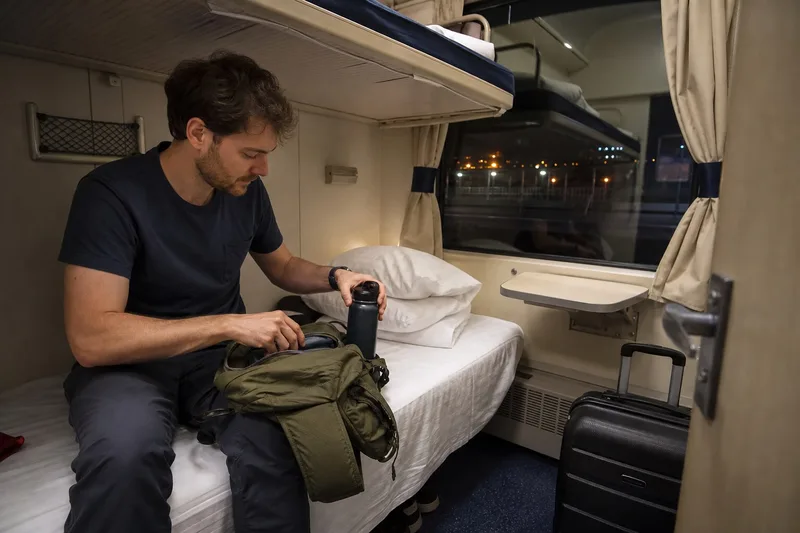
Do not treat an overnight train like a normal daytime transfer. Put the items you will use before sleep and immediately after arrival in one compact bag: passport, tickets, phone, power bank, charging cable, payment method, water, basic toiletries, medication, earplugs, a light layer, and one change of clothes.
Keep the larger suitcase organized but avoid repeatedly opening it in a narrow aisle or near a berth. The goal is to know exactly where your essential items are when the carriage lights are low and other passengers are settling in.
Protect Valuables Without Becoming Anxious
Keep passports, money, cards, medication, electronics, and other essential items on your person or in the small bag beside you. Do not leave them loose on bedding, a table, or a window ledge. Use zipped compartments and keep the bag in a consistent place when you sleep.
This is not a reason to expect a problem. It is a simple way to avoid an avoidable one when you are tired, moving through a station, or waking up quickly before arrival. For broader document preparation, see entry documents to check before traveling to China.
Expect Shared-Space Etiquette
Berths and compartments can involve other passengers, changing light levels, conversation, luggage movement, and different sleep schedules. Keep phone sound low, use headphones, pack quietly, and avoid spreading clothes or bags across shared space.
If you need to board late or leave early, prepare your shoes, jacket, small bag, and essential documents in advance. That lets you move without searching through luggage while other people are asleep.
Plan for Sleep, Not Perfect Sleep
Even a comfortable berth is still a moving train. Earplugs, an eye mask, a light layer, and a charged phone can make the night easier. Avoid making the next day depend on a perfect eight hours of sleep. Build in a slower first morning, especially if the train arrives early.
If you are sensitive to noise, motion, or temperature, use a daytime train or flight when the route gives you a better arrival. An overnight service is most useful when it supports the itinerary rather than forcing you into an exhausting first day.
Check Food, Water, Toilets, and Charging Early
Facilities and availability can differ by train and carriage. Carry water and a few simple snacks, especially when you board late or have dietary needs. Find the restroom and check your own charging setup before you settle in for the night.
Do not rely on a particular outlet, food selection, or service arrangement until you see what is available on your train. A charged power bank is a safer backup than assuming the berth area will solve every phone-battery need. For charging preparation, read power bank and phone charging tips for China travel.
Set an Arrival Alarm and Keep the Morning Simple
Set an alarm before your scheduled arrival and pack your small bag before sleeping. Morning arrivals can be busy, and you may need to collect items, find your carriage exit, and navigate a large station quickly.
Save the hotel address in Chinese, the next transport plan, and any booking details offline. If the room will not be ready, have a luggage and arrival plan rather than trying to improvise outside the station. This guide can help: how to plan a comfortable arrival day in China.
Useful Phrases to Save
- Which platform does this train leave from?
- Where is my carriage and berth?
- What time does the train arrive?
- Where is the restroom?
- Is there a place to charge my phone?
- Could you write the arrival station name for me?
Quick Checklist
- Confirm the departure and arrival station, not only the city name.
- Pack a small night-train bag with documents, water, charging, and sleep items.
- Keep passports, cards, medication, and electronics with you.
- Use headphones and keep shared-space noise low.
- Carry a light layer and plan for imperfect sleep.
- Set an arrival alarm and prepare your morning items before sleeping.
- Save the hotel address and next transport plan offline.
The Main Point
An overnight train works best when it gives you a calmer route and a realistic arrival plan. Pack for the night separately, protect essentials, expect shared space, and leave your first morning flexible. Those small choices make the journey easier to manage from boarding to hotel check-in.