

Updated on May 29, 2026. One of the most common questions about China’s 240-hour visa-free transit policy is not only “Am I eligible?” but “Where can I actually go after I enter China?” The answer depends on the official entry port and the permitted stay area attached to that port. It is not enough to know the name of a popular city.
This guide explains the city and region side of the 240-hour visa-free transit policy. For the basic eligibility rules, route requirement, documents, and when a visa is safer, read our earlier guide: China 240-hour visa-free transit explained for first-time visitors.
The main official source for this article is the National Immigration Administration announcement dated November 3, 2025, including its appendix on eligible ports and permitted stay areas. The NIA announcement says the policy covers 65 ports in 24 province-level regions and that the visa-free stay period is calculated from 0:00 on the day following the day of entry.
First principle: city, port, and permitted area are different
Many travelers search for a city name, such as Shanghai, Beijing, Guangzhou, Chengdu, Xi’an, or Kunming. That is useful, but it is not enough. The policy is organized by eligible ports and permitted stay areas.
An eligible port is where you can apply for temporary entry under the 240-hour transit policy. It may be an airport, passenger seaport, railway port, or other official port. The permitted stay area is where you may travel after entry. Sometimes the permitted area is a full municipality or province. Sometimes it is only specific cities inside a province-level region.
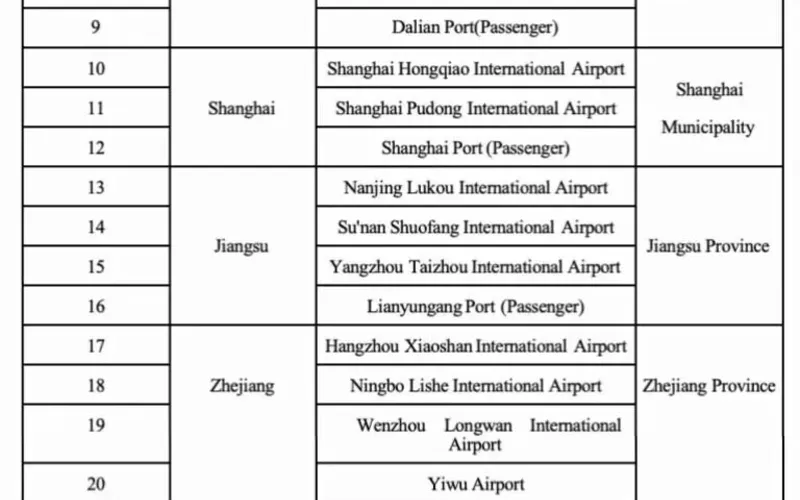
For example, Shanghai’s listed eligible ports include Shanghai Hongqiao International Airport, Shanghai Pudong International Airport, and Shanghai Port for passengers, with the permitted stay area listed as Shanghai Municipality. Jiangsu and Zhejiang have their own eligible ports and permitted province-wide areas. That does not mean every China city is automatically included, but it also does not mean a traveler entering through Beijing is limited only to Beijing. The NIA appendix separately states that visa-free transit travelers may make cross-province visits within the permitted areas of the 24 listed province-level regions.
Full municipality or full province permitted areas
According to the NIA appendix, many areas are straightforward because the permitted stay area is the entire municipality or province. Travelers still need to enter through an eligible port and meet the route and onward-ticket rules, but the area description itself is broad.
| Permitted stay area | Examples of eligible ports listed by NIA | Practical meaning for travelers |
|---|---|---|
| Beijing Municipality | Beijing Capital International Airport, Beijing Daxing International Airport | Beijing city travel is inside the permitted area. |
| Tianjin Municipality | Tianjin Binhai International Airport, Tianjin Port (Passenger) | Tianjin travel is inside the permitted area. |
| Hebei Province | Shijiazhuang Zhengding International Airport, Qinhuangdao Port (Passenger) | Hebei province travel is inside the permitted area. |
| Liaoning Province | Shenyang Taoxian International Airport, Dalian Zhoushuizi International Airport, Dalian Port (Passenger) | Shenyang, Dalian, and other Liaoning destinations are inside the permitted province. |
| Shanghai Municipality | Shanghai Hongqiao International Airport, Shanghai Pudong International Airport, Shanghai Port (Passenger) | Shanghai travel is inside the permitted area. |
| Jiangsu Province | Nanjing Lukou International Airport, Su'nan Shuofang International Airport, Yangzhou Taizhou International Airport, Lianyungang Port (Passenger) | Nanjing, Suzhou/Wuxi-area trips, Yangzhou, and other Jiangsu destinations are inside the permitted province. |
| Zhejiang Province | Hangzhou Xiaoshan International Airport, Ningbo Lishe International Airport, Wenzhou Longwan International Airport, Yiwu Airport, Wenzhou Port, Zhoushan Port | Hangzhou, Ningbo, Wenzhou, Yiwu, Zhoushan, and other Zhejiang destinations are inside the permitted province. |
| Anhui Province | Hefei Xinqiao International Airport, Huangshan Tunxi International Airport | Hefei, Huangshan, and other Anhui destinations are inside the permitted province. |
| Fujian Province | Fuzhou Changle International Airport, Xiamen Gaoqi International Airport, Quanzhou Jinjiang International Airport, Wuyishan Airport, Xiamen Port (Passenger) | Fuzhou, Xiamen, Quanzhou, Wuyishan, and other Fujian destinations are inside the permitted province. |
| Shandong Province | Jinan Yaoqiang International Airport, Qingdao Jiaodong International Airport, Yantai Penglai International Airport, Weihai Dashuipo International Airport, Qingdao Port (Passenger) | Jinan, Qingdao, Yantai, Weihai, and other Shandong destinations are inside the permitted province. |
| Henan Province | Zhengzhou Xinzheng International Airport | Zhengzhou and other Henan destinations are inside the permitted province. |
| Hubei Province | Wuhan Tianhe International Airport | Wuhan and other Hubei destinations are inside the permitted province. |
| Hunan Province | Changsha Huanghua International Airport, Zhangjiajie Hehua International Airport | Changsha, Zhangjiajie, and other Hunan destinations are inside the permitted province. |
| Guangdong Province | Guangzhou Baiyun International Airport, Shenzhen Bao'an International Airport, Jieyang Chaoshan International Airport, Nansha Port, Shekou Port, Guangzhou Pazhou Ferry Terminal, Zhongshan Port, Hengqin Port, Hong Kong-Zhuhai-Macao Bridge Port, West Kowloon Station Port of the Guangzhou-Shenzhen-Hong Kong Express Rail Link | Guangzhou, Shenzhen, Zhuhai, Zhongshan, and other Guangdong destinations are inside the permitted province. The NIA table notes exits are available at all open ports across Guangdong. |
| Hainan Province | Haikou Meilan International Airport, Sanya Phoenix International Airport | Haikou, Sanya, and other Hainan destinations are inside the permitted province. |
| Chongqing Municipality | Chongqing Jiangbei International Airport | Chongqing travel is inside the permitted area. |
| Guizhou Province | Guiyang Longdongbao International Airport | Guiyang and other Guizhou destinations are inside the permitted province. |
| Shaanxi Province | Xi'an Xianyang International Airport | Xi'an and other Shaanxi destinations are inside the permitted province. |
This table is simplified for trip planning. Travelers should still verify the exact official port name, route, and onward ticket before relying on the policy.
Limited-city permitted areas
Some province-level regions are not listed as full-province travel areas. They are limited to specific cities or prefectures in the NIA appendix. This is where first-time visitors most often make mistakes.
| Province-level region | Eligible port listed by NIA | Permitted stay area listed by NIA |
|---|---|---|
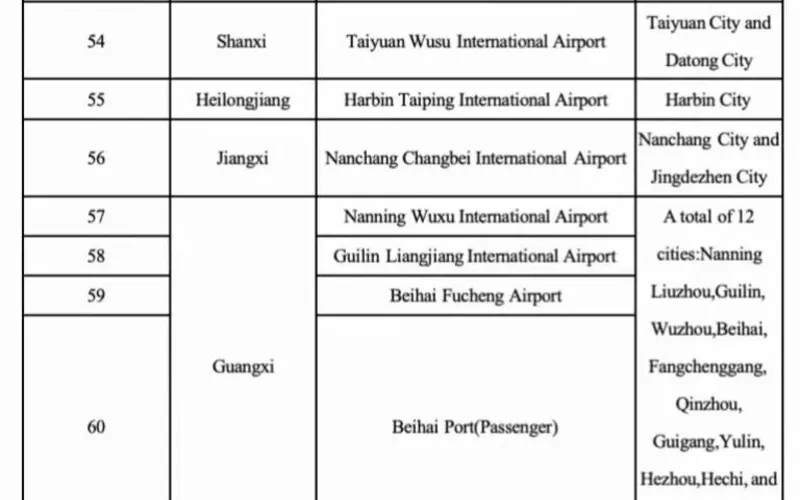
| Shanxi | Taiyuan Wusu International Airport | Taiyuan City and Datong City. |
| Heilongjiang | Harbin Taiping International Airport | Harbin City. |
| Jiangxi | Nanchang Changbei International Airport | Nanchang City and Jingdezhen City. |
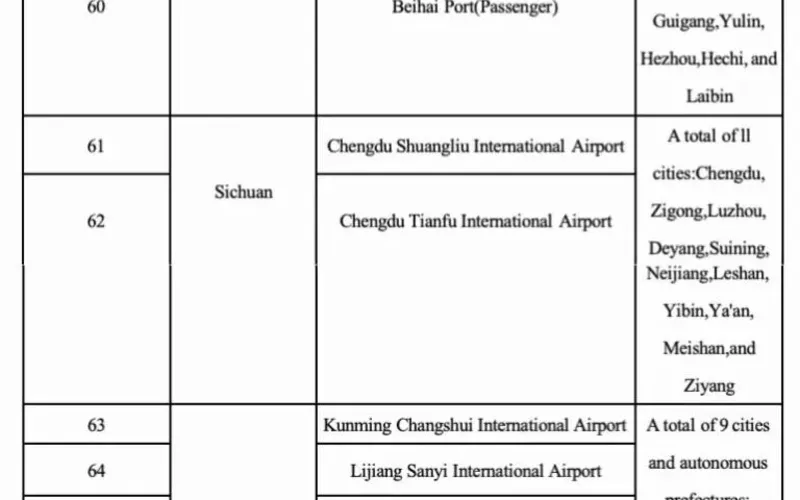
| Guangxi | Nanning Wuxu International Airport, Guilin Liangjiang International Airport, Beihai Fucheng Airport, Beihai Port (Passenger) | Nanning, Liuzhou, Guilin, Wuzhou, Beihai, Fangchenggang, Qinzhou, Guigang, Yulin, Hezhou, Hechi, and Laibin. |
| Sichuan | Chengdu Shuangliu International Airport, Chengdu Tianfu International Airport | Chengdu, Zigong, Luzhou, Deyang, Suining, Neijiang, Leshan, Yibin, Ya'an, Meishan, and Ziyang. |
| Yunnan | Kunming Changshui International Airport, Lijiang Sanyi International Airport, Mohan Railway Port | Kunming, Yuxi, Chuxiong, Honghe, Wenshan, Pu'er, Xishuangbanna, Dali, and Lijiang. |
If a city is not inside the listed permitted area for the region you plan to use, do not assume it is allowed simply because it is in the same province. Apply for a visa or redesign the route if the city is essential.
Can you visit several provinces during the 240 hours?
The NIA appendix states that visa-free transit travelers can make cross-province visits in the permitted areas of the 24 province-level regions for no more than 240 hours. This is important because the current policy is more flexible than older city-by-city transit arrangements.
In practical terms, a traveler may be able to design a route that includes more than one permitted area if the route, ports, documents, and timing remain valid. A traveler entering through Beijing, for example, is not automatically restricted to Beijing only. Beijing - Xi'an - Shanghai can be possible under the current cross-province rule because Beijing Municipality, Shaanxi Province, and Shanghai Municipality are all listed permitted areas. The traveler still needs to remain within listed permitted areas, leave within 240 hours, and hold a confirmed onward ticket to a third country or region.
This is different from saying “anywhere in China is allowed.” If a destination is outside the NIA permitted areas, or outside a limited city list such as parts of Sichuan, Yunnan, Guangxi, Jiangxi, Shanxi, or Heilongjiang, the traveler should not include it under 240-hour visa-free transit. A safer planning method is to keep the first China itinerary compact and make every hotel city easy to match against the official table.
Can you enter in Beijing and leave from Shanghai?
In many real itineraries, yes, this can be possible under the current 240-hour transit framework, but only if the whole route is a valid transit route and all China stops stay inside the permitted areas. The exit city does not always have to be the same as the entry city. What matters is that the entry port, exit port, permitted travel areas, onward ticket, and 240-hour limit all fit the official policy.
These examples show how to think about it:
- Example 1: London - Beijing - Xi'an - Shanghai - Tokyo. This can be a reasonable 240-hour transit idea if the traveler is eligible, enters through an eligible Beijing port, visits only listed permitted areas, leaves from an eligible Shanghai port, and holds a confirmed onward ticket to Tokyo within 240 hours. Beijing, Shaanxi, and Shanghai are all in the NIA permitted-area framework.
- Example 2: New York - Beijing - Shanghai - Hong Kong. This can also be possible if the traveler meets all requirements and Hong Kong is accepted as the onward region for the route. The traveler should keep the onward ticket and hotel details ready for airline and border checks.
- Example 3: Paris - Beijing - Xi'an - Shanghai - Paris. This is usually not a safe 240-hour transit plan because the route returns to the same country instead of continuing to a third country or region. A normal visa or another valid entry basis would be safer.
- Example 4: Singapore - Chengdu - Jiuzhaigou - Singapore. This may fail for two reasons: it returns to the same country and Jiuzhaigou is not one of the Sichuan cities listed in the NIA appendix for this policy. The traveler should not rely on 240-hour transit for that plan.
These are planning examples, not border guarantees. Airlines and immigration inspection authorities still check the actual passport, ticket, entry port, exit port, stay area, and travel purpose.
Popular first-time route ideas
The examples below are planning ideas, not legal guarantees. They assume the traveler is from an eligible country, has a valid passport, enters through an eligible port, holds a confirmed onward ticket to a third country or region, and stays inside the permitted area.
- Shanghai entry: Shanghai only, or Shanghai plus nearby Jiangsu/Zhejiang planning such as Suzhou or Hangzhou, if the itinerary stays within the permitted areas and timing is realistic.
- Beijing entry: Beijing only, or Beijing plus other listed permitted areas such as Xi'an in Shaanxi Province or Shanghai Municipality, if transport time, onward-ticket timing, and the cross-province permitted-area rule all remain clear.
- Guangdong entry: Guangzhou, Shenzhen, Zhuhai, or other Guangdong destinations, with attention to the listed ports and onward third-destination route.
- Chengdu entry: Chengdu with nearby permitted Sichuan cities such as Leshan, but not an unrestricted western Sichuan itinerary unless the city is included in the NIA list.
- Kunming or Lijiang entry: Yunnan planning must stay within the listed cities and autonomous prefectures, such as Kunming, Dali, Lijiang, and Xishuangbanna.
Before committing to a route, also check the practical arrival side. Our guide to China airport arrival support explains why airport exit flow, pickup timing, hotel check-in, and first-day transport should be planned separately from visa-free eligibility.
Entry port and exit port are not always the same question
Many travelers ask whether they must leave from the same city where they entered. The better question is whether the entry port, exit port, permitted area, and onward third-destination ticket all fit the current official policy. Guangdong is especially notable because the NIA table says exits are available at all open ports across the province.
Do not design a route based only on airline price. A cheap ticket can become a problem if the airport, railway port, passenger port, or onward destination does not match the transit policy. If the itinerary uses Hong Kong, Macao, or Taiwan as the onward region, check the airline’s acceptance and keep proof of the onward ticket available before check-in.
What to verify before booking hotels or trains
After confirming basic eligibility, verify these details before paying for non-refundable hotels, train tickets, or local tours:
- Your passport country is on the current NIA 240-hour transit list.
- Your China entry port appears in the official eligible-port list.
- Your hotel city appears in the permitted stay area for your plan.
- Your onward destination is a third country or region, not simply a return to the same place you came from.
- Your onward ticket has a confirmed seat and departure date.
- Your route has enough time buffer for immigration, baggage, customs, transfer, and delays.
- You have offline copies of the official policy page, tickets, hotel details, and local contact information.
If your flight changes, your onward-ticket timing changes, or you arrive late at night, review our guide on what to do if your flight to China is delayed, changed, or arrives late. A policy-compliant plan still needs a backup if airline timing changes.
When a visa is safer than 240-hour transit
Apply for a visa instead of relying on 240-hour transit if the city you want is outside the listed permitted area, if your trip is a simple round trip to China, if your purpose involves work, study, or reporting, if your onward ticket is not confirmed, or if your plan depends on a borderline interpretation of the route.
For a normal multi-city China holiday, a visa can be simpler than trying to force the trip into a transit rule. The 240-hour policy is best for a clean stopover or a carefully designed short China visit between two international destinations.
Quick city-planning checklist
- I know the exact entry port, not just the city name.
- I know whether the permitted area is a municipality, full province, or limited list of cities.
- Every hotel city in my itinerary is inside a listed permitted area.
- My route is origin country or region - China - third country or region.
- I have a confirmed onward ticket and enough time buffer.
- I have checked the NIA page and not only a travel forum or social post.
If you already have a route and need help with arrival-side planning, official support communication, or booking handover details after confirming your entry basis, use the Jiangmi Travel official contact page. For broader preparation, use our first China trip pre-departure checklist.
Official references
- National Immigration Administration: Announcement on expanding 240-hour visa-free transit policy and appendix on eligible ports and permitted stay areas.
- National Immigration Administration: Visa-Free Transit Policies.
- National Immigration Administration for current entry and border inspection information.